FSE AI Faculty Resource Center
Preparing engineers for an AI-enabled future
Artificial intelligence is transforming how engineers learn, work, solve problems, and create new technologies. In addition to domain knowledge, the Fulton Schools of Engineering is preparing students to become AI-capable engineers, not simply AI tool users, through a shared approach to AI awareness, literacy, and capability across FSE academic programs.
The FSE AI Competency Model
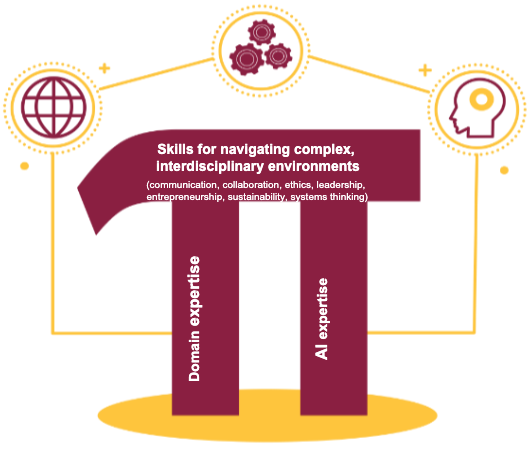
What are we preparing our students to do?
The FSE approach is designed to help every engineering student develop a foundation in AI, while programs build deeper, discipline-specific capabilities throughout the curriculum.
Understand what AI is, where it is used, how it is transforming engineering practice, and its ethical and societal implications.
Understand how AI systems work, how data drives them, interact effectively with AI tools, and evaluate their outputs critically.
Design, evaluate, integrate, and deploy AI-enabled systems within a specific engineering discipline.
What does this mean for faculty?
Faculty are central to helping students develop AI competencies.
Integrating AI into engineering education is about more than adopting new tools and deciding whether students may use AI on an assignment. It is the intentional design of learning experiences that help students develop the knowledge, judgment, technical fluency, and responsible practices they will need as engineers working alongside AI.
As FSE integrates AI across all academic programs, faculty have a critical role in helping students progress from foundational AI awareness and literacy to discipline-specific AI capability.
Growing our capacity to teach in an AI-enabled environment
The FSE AI Competency Model also provides a framework for faculty development.
Understand AI in teaching and learning
Develop an understanding of AI, its capabilities and limitations, and its implications for teaching, learning, assessment, and engineering education.
Integrate AI into teaching
Intentionally incorporate AI into teaching and learning experiences, using AI tools and approaches in ways that support student learning and the development of AI competencies.
Design AI-integrated curriculum
Design courses, curriculum, and learning experiences that meaningfully incorporate AI and help students develop AI capabilities within their discipline.
Where are you in your AI teaching journey?
There is no single starting point, and faculty will engage with AI in different ways. The goal is not for every faculty member to use AI in the same way. The goal is to develop the knowledge and confidence to make informed, intentional decisions about AI in teaching and learning.
Choose the stage that sounds most like you today.
Cautious curiosity
You are beginning to explore what AI means for teaching and learning and are looking for a place to start.
See starting points →Testing the waters
You are experimenting with AI tools and approaches and beginning to consider how they might fit into your teaching.
See starting points →Intentional and consistent
You are using AI intentionally in your teaching and learning, sharing practices, and helping shape how FSE responds to AI.
See starting points →Leaders and shapers
You are advancing AI-integrated teaching and learning, sharing practices, and helping shape how FSE responds to AI.
See starting points →New to the tools?
If you have not used an AI tool much, or a first attempt did not go well, start with AI Basics. It covers what these tools do well, how to test one safely, and how to ask so the answer is worth having. Then come back and choose a stage above.
Two kinds of AI you will hear about
Most of what faculty encounter falls into one of two categories. The same product often does both, which is why the distinction is easy to miss. In one sentence: generative AI responds to a request, and agentic AI pursues a goal.
Generative AI
Produces something when you ask for it: text, code, images, or audio. It answers, then stops and waits for you. Every step after that is yours. This is what most people mean when they say "AI" today, and it is what most of this site describes.
In ChatGPT, that looks likeWrite five multiple-choice questions on Ohm's law.
It writes them and stops.
Agentic AI
Takes a goal and works out the steps to reach it, carrying them out before reporting back. It can search, read, discard, revise, and retry without checking with you along the way. You see the result rather than the route.
In ChatGPT, that looks likeFind how three other universities handle AI in engineering syllabi and summarize the differences.
It runs several searches and reads pages before answering.
Same tool, same login. What changed is how much you handed over. Common examples of both include ChatGPT, Microsoft Copilot, Claude, and Google Gemini, several of which ASU offers in its own supported versions. ASU describes how it is applying agentic AI across the university on ai.asu.edu.
Why the difference matters for your course
Two things change when a tool works autonomously. An agentic tool can carry out a multi-step assignment end to end, including the literature search, the draft, and the revision, so assignments built to resist AI need rethinking. The AI-Supported Teaching page covers formats that hold up. Verification also gets harder: with generative output you can read the reasoning and spot the error, while with agentic output you get a conclusion and have to trust steps you never saw.
Ready to take your next step?
Explore resources, examples, strategies, and opportunities designed to support you wherever you are in your AI teaching journey.
Tool availability and terms change over time. For the complete, current list of what ASU offers and what is approved for use with ASU data, see ai.asu.edu/ai-tools.
AI Basics
What these tools do reliably, how to test one before relying on it, and how to ask so the answer is worth having.
Learn the tools → 02AI-Supported Teaching
Tools you can use today, ASU colleagues who have already tried this, and example assignments by engineering subject.
Apply it to your course → 03AI Guidance
Official ASU guidance and sample syllabus language, plus student-facing guidance you can adapt and share with your class.
Set your policy →For binding policy, check the source
This page gathers and explains existing ASU resources. The rules that actually govern your course or your work live in your syllabus, your academic unit, and ASU's official pages, which are linked throughout.